
Flexitank & ISO Tank Logistics Across Central Asia
Flexitank and ISO Tank Logistics Across Central Asia and the Caucasus
Short answer: Kricon Group moves liquid bulk cargo — chemicals, edible oils, base oils and non-hazardous industrial liquids — into and out of Kazakhstan, Uzbekistan, Turkmenistan, Tajikistan, Kyrgyzstan, Georgia, Azerbaijan and Armenia using flexitanks and ISO tank containers, combined with its own trucking fleet, cleaning stations and depot network along the Middle Corridor.
Why this region needs a dedicated liquid bulk strategy
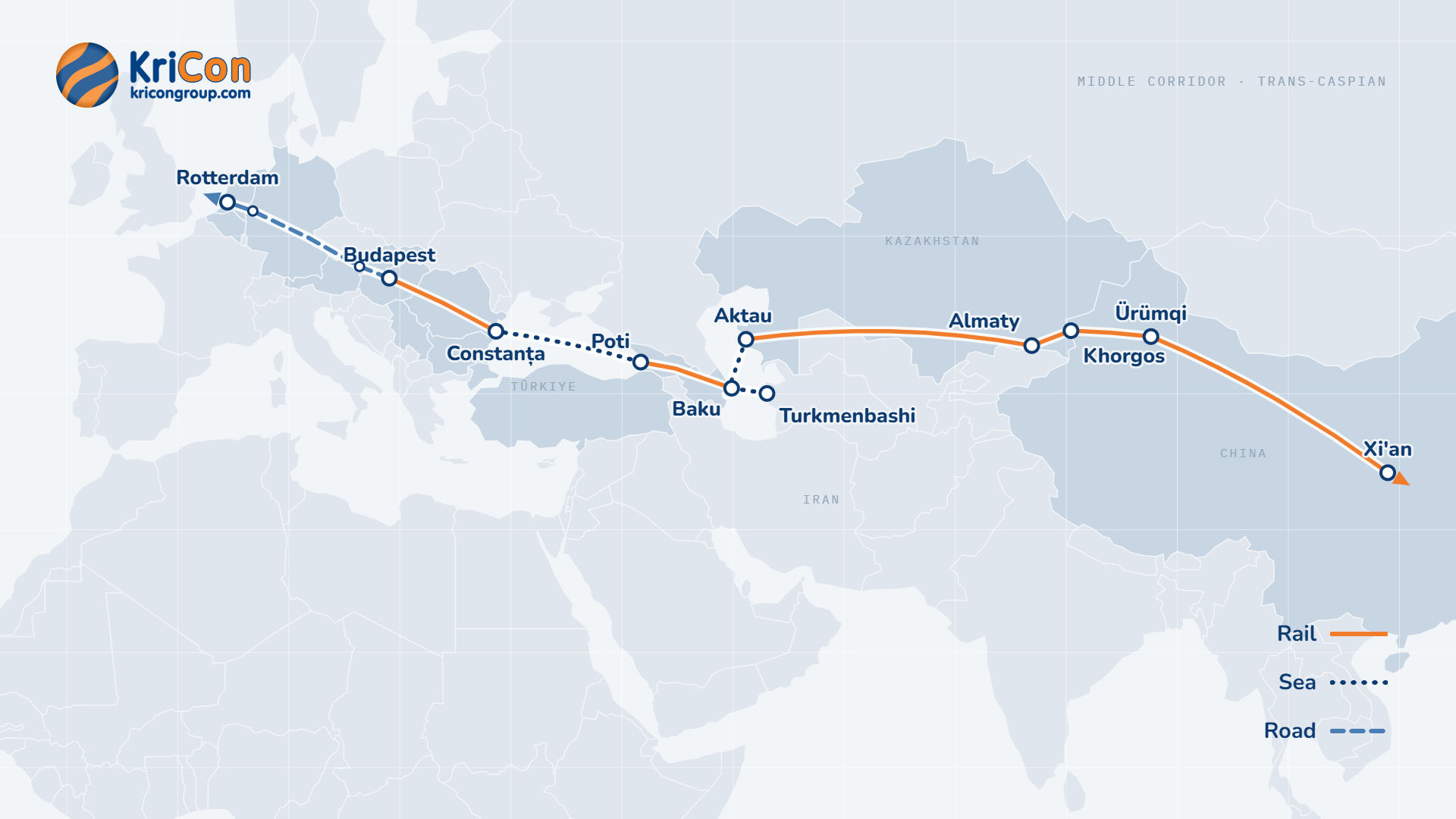
Central Asia and the Caucasus sit on one of the fastest-growing trade corridors in the world. The Trans-Caspian International Transport Route — commonly called the Middle Corridor — links China and Central Asia to Europe through Kazakhstan’s Caspian ports, across the sea to Azerbaijan, and on through Georgia’s Black Sea ports or the Baku–Tbilisi–Kars railway into Turkey and the EU. Cargo volumes on this corridor roughly doubled in 2022 alone, and traffic through Turkey’s link to the route has grown sixfold over the past decade, as shippers look for a reliable alternative to routes running through Russia.
That growth brings a practical problem for anyone shipping liquids: this is a landlocked and semi-landlocked region, cargo frequently changes between rail, road and sea, and it crosses several customs territories in a single journey. A packaging or container choice that works for a single sea leg often breaks down once it has to survive rail-ferry-rail-truck handling between Aktau, Alyat, Poti and a final inland destination. Flexitanks and ISO tank containers, used correctly, solve that problem.
Flexitank: the flexible, cost-efficient option
A flexitank is a single-use, food-grade multi-layer bag installed inside a standard 20-foot dry container, typically holding 14,000–24,000 litres of non-hazardous liquid. For the Central Asian and Caucasus lanes, it is often the more economical choice because:
- It uses standard dry containers, which are far easier to reposition across Kazakhstan, Uzbekistan and the Caucasus than specialised tank equipment, reducing empty-running costs.
- It suits one-way flows that are common on these routes — for example, edible oils moving out of Kazakhstan and Uzbekistan, or chemicals and base oils moving in.
- It is fitted and discharged quickly (typically 20–45 minutes each way) at inland depots, which matters when cargo has to keep moving through multi-modal Middle Corridor handoffs.
Kricon Group already operates flexitank depots and certified fitting teams across Kazakhstan, Azerbaijan and Turkmenistan, supported by 24-hour technical support and full liability insurance on every shipment.
ISO tank container: for hazardous, sensitive or repeat cargo
An ISO tank container is a reusable, stainless-steel pressure vessel built to a T-code rating (T1–T22), mounted in a standard container frame. It is the right choice when cargo is hazardous, temperature-sensitive, needs to be reused on the same trade lane repeatedly, or must meet stricter food-safety or chemical-compatibility standards than a flexitank can offer. Kricon Group’s fleet of 2,000+ tank containers, backed by its own cleaning and depot stations, gives shippers on the Kazakhstan–Caucasus–Europe axis a tank that can be cleaned, re-certified and reloaded without waiting for equipment to cycle back from Western Europe.
The route in practice
| Leg | Typical gateway | Role in the corridor |
|---|---|---|
| Kazakhstan (Caspian) | Aktau / Kuryk | Main westbound departure point from Central Asia; Aktau alone handles roughly 12 million tonnes/year across its dry and oil terminals |
| Caspian Sea crossing | Aktau–Alyat ferry | Rail-ferry-rail link between Kazakhstan and Azerbaijan |
| Azerbaijan | Alyat (Baku) | Primary transfer point onto rail or road toward Georgia and Turkey; roughly 15 million tonnes/year currently, with expansion underway |
| Georgia | Poti / Batumi | Black Sea outlet when cargo bypasses the Baku–Tbilisi–Kars railway |
| Onward | Baku–Tbilisi–Kars railway | Direct rail link from Azerbaijan through Georgia into Turkey and the EU |
Kricon Group’s own trucking division — more than 30 vehicles across three regions — and its regional offices mean cargo does not have to sit and wait between these handoffs; drayage, depot fitting and documentation are coordinated end to end rather than handed between unconnected local agents.
Which cargo types move well on this corridor
- Edible and vegetable oils (sunflower, cotton, rapeseed) exported from Kazakhstan and Uzbekistan — flexitank is usually the default choice.
- Base oils, lubricants and non-hazardous chemicals moving in either direction — flexitank or ISO tank, depending on volume and reuse frequency.
- Wine, juice concentrate and other food-grade liquids out of Georgia and Armenia — flexitank, subject to compatibility testing.
- Hazardous or classified chemicals, and fuel additives — ISO tank container only, matched to the correct T-code.
Frequently asked questions
Can flexitanks be used across all five Central Asian countries and the Caucasus? Yes, for non-hazardous liquids. Depot availability and fitting capacity vary by country, which is why Kricon Group maintains its own depots and fitting teams in Kazakhstan, Azerbaijan and Turkmenistan rather than relying only on third-party stations.
Is the Middle Corridor reliable enough for regular liquid bulk shipments? It has grown rapidly, but it is a multi-modal route with real capacity constraints at ports and on rail, and no single unified tariff or operator across the whole corridor. That is exactly why working with an operator that controls trucking, depots and cleaning at each handoff point reduces the risk of delay.
How do I choose between flexitank and ISO tank for a Central Asian shipment? As a rule of thumb: non-hazardous, one-way, standard-grade liquid cargo favours flexitank; hazardous, temperature-controlled, or repeat-lane cargo favours ISO tank containers. Kricon Group’s logistics team reviews the cargo, route and frequency before recommending equipment.
Which ports matter most for this region? Aktau and Kuryk in Kazakhstan for departure across the Caspian; Alyat (Baku) in Azerbaijan as the main transfer point; Poti and Batumi in Georgia as Black Sea alternatives when the Baku–Tbilisi–Kars railway is not used.
Talk to Kricon Group about your route
Kricon Group has operated liquid bulk logistics since 2010, with 2,000+ tank containers, its own trucking fleet, and depot and cleaning stations spanning Kazakhstan, Azerbaijan, Turkmenistan and beyond. Contact our flexitank and ISO tank team to review your commodity, route and volumes across Central Asia and the Caucasus.