
What Is an ISO Tank Container? A Complete Guide to Tank Container Logistics
Published: May 26, 2026 | Kricongroup | Category: Bulk Liquid Logistics
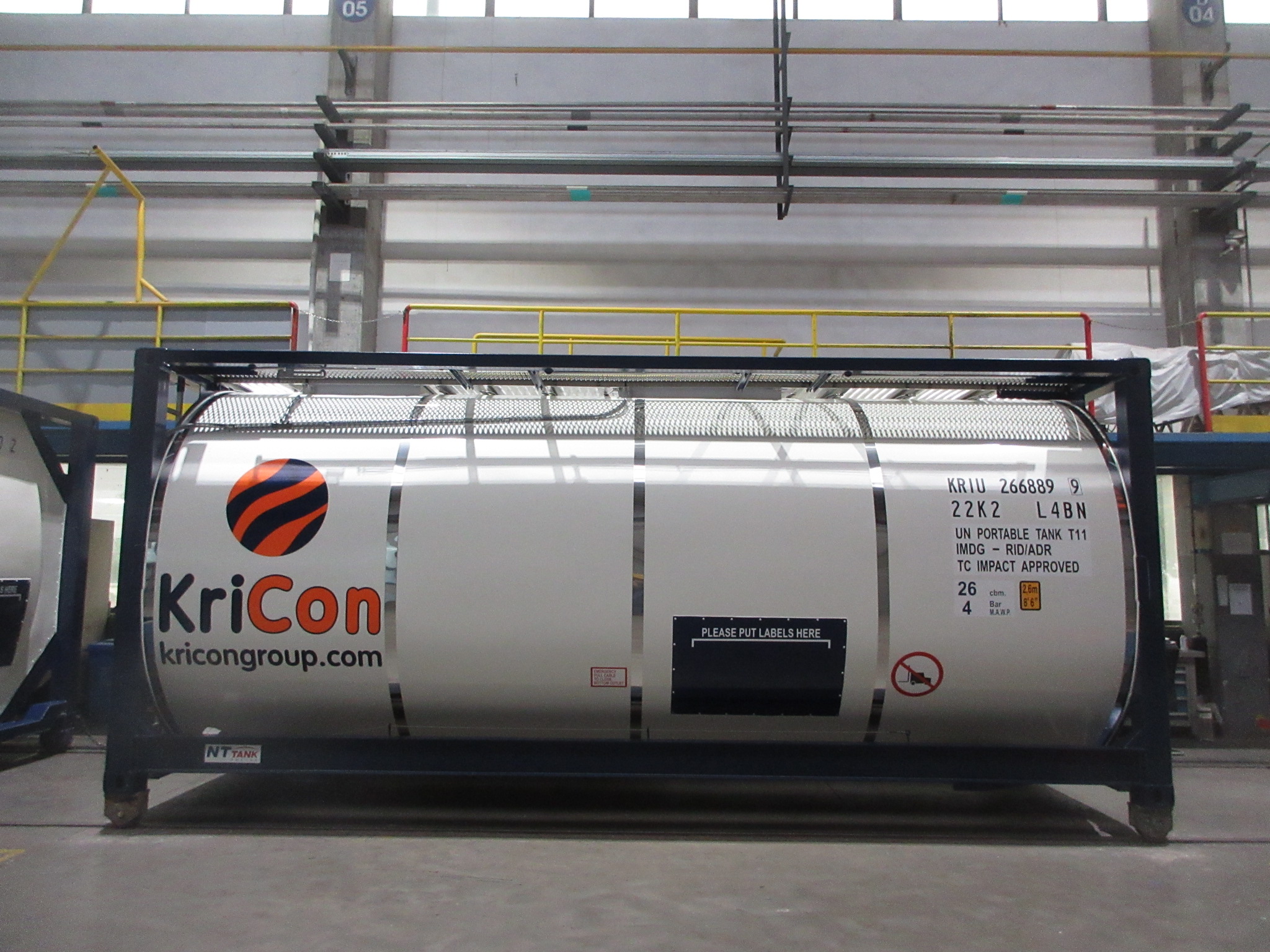
An ISO tank container is a stainless steel pressure vessel mounted inside a standardised ISO frame — typically with a 20-foot footprint — designed to transport liquid, gaseous, or powdered cargo by sea, rail, and road. Unlike flexitanks, ISO tank containers are certified for both non-hazardous and hazardous materials under the IMDG Code, ADR, and RID regulations, making them the standard solution for chemicals, petrochemicals, and food-grade liquids that require a reusable, multi-modal, pressure-rated vessel. A single ISO tank container has a typical capacity of 17,000 to 26,000 litres and a service life of 15 to 25 years.
How Does an ISO Tank Container Work?
An ISO tank container consists of a cylindrical inner vessel — almost always 316L austenitic stainless steel — welded inside a rectangular galvanised steel outer frame that conforms to ISO 668 corner casting dimensions. This frame allows the tank to be handled identically to a standard shipping container: it can be lifted by spreader bar, stacked up to three units high, and loaded onto container vessels, flatbed rail wagons, and road semi-trailers without special equipment.
The vessel is accessed through a top manhole (for loading, inspection, and venting) and a bottom outlet valve for discharge. Many tanks are fitted with heating coils — either steam or electric — that run around the exterior of the inner vessel, allowing viscous cargoes such as palm oil, bitumen, or certain chemicals to be kept at a controlled temperature throughout the voyage.
Before each new cargo, the tank must be inspected and cleaned to the standard required by the next product. Independent inspection companies issue cleaning certificates that accompany the tank. Periodic testing — typically every 2.5 years for routine inspection and every 5 years for pressure testing — is mandatory under CSC (Container Safety Convention) requirements.
ISO Tank T-Code Classification: What Do T-Codes Mean?
Every ISO tank container used for dangerous goods must carry a UN Portable Tank Instruction — known as a T-code — assigned in the IMDG Code and the UN Model Regulations. The T-code defines the minimum design pressure and construction requirements needed to safely carry a given substance. T-codes range from T1 (lowest pressure, least hazardous cargo) through T22 (cryogenic liquefied gases at very high pressure). The most commercially significant codes are:
| T-Code | Min. Test Pressure | Typical Cargo | Common Applications |
| T1 | 1.5 bar | Non-hazardous, low-pressure liquids | Edible oils, food-grade liquids, wine |
| T4 | 1.5 bar | Non-hazardous, higher spec | Glycerin, corn syrup, non-classified chemicals |
| T7 | 4.0 bar | Flammable liquids (IMDG Class 3) | Ethanol, solvents, flammable industrial chemicals |
| T11 | 4.0 bar | Toxic & flammable liquids | Industrial chemicals, Class 3/6 overlap cargoes |
| T14 | 6.5 bar | Toxic and corrosive substances | Acids, Class 8 corrosives, speciality chemicals |
| T20 | 2.65 bar | Refrigerated liquefied gases | Liquid nitrogen, liquid oxygen, LNG |
| T22 | High pressure | Deeply refrigerated cryogenic gas | Liquid helium, cryogenic industrial gases |
For non-hazardous cargoes — edible oils, food ingredients, non-classified industrial liquids — a T1 or T4 tank is typically sufficient. For chemical shippers handling classified substances, it is critical to verify the correct T-code in the substance’s IMDG entry before booking equipment. Using an under-rated tank for a classified substance is a regulatory violation with significant liability implications.
ISO Tank Container Technical Specifications
Standard 20-foot ISO tank containers conform to the following specifications. Variations exist between manufacturers and T-code ratings — always confirm with the tank operator for the specific equipment assigned:
| Specification | Standard Value / Range |
| Frame dimensions (external) | 6,058 mm (L) × 2,438 mm (W) × 2,591 mm (H) — standard 20ft ISO |
| Inner vessel capacity | 21,000 – 26,000 litres (varies by design and T-code) |
| Tare weight (empty) | 3,500 – 4,500 kg depending on tank type and fittings |
| Maximum gross weight | 34,000 – 36,000 kg (36 tonnes for most modern tanks) |
| Inner vessel material | 316L austenitic stainless steel (standard); carbon steel for select products |
| Shell thickness | 4 – 8 mm depending on pressure rating and T-code |
| Design pressure (standard) | 4.0 bar (T7/T11); 1.5 bar (T1/T4); up to 6.5 bar (T14+) |
| Operating temperature range | -40°C to +130°C (with heating coils; varies by T-code) |
| Heating system (optional) | Steam coil (6 bar max) or electric heating jacket |
| Top manhole diameter | 500 mm (standard) — for loading, venting, inspection |
| Bottom outlet valve | 3-inch (76mm) or 4-inch (100mm) ball or butterfly valve |
| Insulation (optional) | 50 – 100 mm polyurethane foam under stainless steel cladding |
| Stacking capability | Up to 3 units high (loaded) |
| Certifications | IMDG, ADR, RID, CSC, ASME (optional), Lloyd’s / DNV / BV approval |
What Commodities Can Be Transported in ISO Tank Containers?
ISO tank containers cover a significantly broader range of cargoes than flexitanks, because they can be pressure-rated, insulated, and certified for dangerous goods. The main commodity categories are:
| Category | Typical Products | Required T-Code (indicative) |
| Food-grade liquids | Edible oils, fruit juices, wine, dairy, glucose syrup | T1 or T4 |
| Non-hazardous industrial liquids | Glycerin, industrial lubricants, base oils, latex | T1 or T4 |
| Flammable liquids (Class 3) | Ethanol, methanol, solvents, toluene | T7 or T11 minimum |
| Toxic substances (Class 6) | Industrial chemicals, agrochemical intermediates | T11 or T14 |
| Corrosive substances (Class 8) | Sulphuric acid, caustic soda, hydrochloric acid | T14 or higher |
| Miscellaneous hazmat (Class 9) | Certain environmentally hazardous liquids | T1–T11 depending on substance |
| Petrochemicals | Base oils, lubricant additives, process chemicals | T4–T11 |
| Cryogenic / liquefied gases | Liquid nitrogen, oxygen, argon, LNG | T20–T22 |
| Powder / granular cargo | Foodstuffs, plastics granules (dry bulk tanks) | Specialised equipment |
Advantages of ISO Tank Containers
- Certified for hazardous materials: This is the defining advantage of an ISO tank. With the correct T-code and UN number compliance, an ISO tank can carry IMDG-classified dangerous goods that are completely prohibited in flexitanks. For chemical and petrochemical shippers, there is often no alternative.
- Reusability and low long-term cost: A single ISO tank container has a service life of 15–25 years and can complete hundreds of round trips. For regular shippers of the same commodity on the same trade lane, amortised equipment costs per trip become very competitive over time.
- Multi-modal without transhipment: ISO tank containers can move from factory gate to final consignee — by road, rail, and sea — without the cargo ever being transferred between vessels. This reduces handling risk, contamination potential, and transit time on complex supply chains.
- Heating for viscous cargo: Steam or electric heating coils maintain product temperature throughout the voyage. This is essential for palm oil, bitumen, certain waxes, and chemical products with high pour points — cargoes that would solidify in an unheated flexitank.
- Higher capacity than flexitanks: Standard ISO tanks hold 21,000–26,000 litres, compared to 16,000–24,000 litres for flexitanks. For dense cargoes where weight — not volume — is the constraint, the higher capacity reduces the number of moves required.
- Pressure capability: ISO tanks are pressure-rated vessels. Cargoes that require a pressurised environment (e.g., certain gases or volatile chemicals) can be transported safely — flexitanks offer no equivalent capability.
Limitations of ISO Tank Containers
- Higher per-trip cost for non-hazmat cargo: For non-classified liquids — particularly edible oils — the total cost of an ISO tank round trip (equipment hire, cleaning, repositioning) often exceeds the all-in cost of a flexitank shipment by 20–40%. Flexitanks are the economically preferred solution for straightforward non-hazmat cargoes.
- Equipment repositioning: ISO tank containers must be returned to their owner’s depot after discharge. Repositioning empty tanks from less-served inland destinations (Central Asia, inland Africa) to active load ports represents a significant cost that flexitanks avoid entirely.
- Cleaning and inspection requirements: Between shipments — especially when switching commodities — the tank must be cleaned and inspected. Cleaning costs vary from USD 150 to over USD 1,000 depending on the previous and next cargo.
- Depot infrastructure requirement: Loading and discharging an ISO tank requires access to a certified depot or terminal with appropriate hoses, pumps, and safety equipment. This limits access in remote or infrastructure-poor origins and destinations.
- Availability constraints: ISO tanks are specialised equipment managed by a limited number of global tank operators. Availability on specific trade lanes, particularly for high T-code equipment, can be constrained during peak periods.
ISO Tank Container vs Flexitank: Choosing the Right Solution
The choice between an ISO tank container and a flexitank is not merely a cost calculation — it is first a regulatory determination, and second an economic one:
Step 1 — Is the cargo classified as dangerous goods under IMDG/ADR?
If yes, an ISO tank container with the appropriate T-code is mandatory. Flexitanks cannot be used for any IMDG-classified substance. This decision is non-negotiable.
Step 2 — Is heating required throughout transit?
If the cargo has a pour point above ambient transit temperatures, an ISO tank with heating coils is required. Standard flexitanks do not provide controlled heating.
Step 3 — What is the economics of the trade lane?
For non-hazardous cargo on a one-way trade lane with no return cargo (e.g., edible oil from Southeast Asia to Europe), a flexitank is almost always the lower-cost option. For regular two-way shipments between fixed points, ISO tank economics can improve substantially.
| Decision Factor | Use Flexitank | Use ISO Tank Container |
| Cargo classification | Non-hazardous only | Hazardous or non-hazardous |
| Heating requirement | Ambient temperature only | Any temperature control needed |
| Trade lane type | One-way, opportunistic | Regular round-trip circuits |
| Infrastructure at destination | Standard container handling | Tank depot required |
| Priority: cost vs capability | Cost minimisation | Full regulatory compliance + capability |
Key Trade Lanes for ISO Tank Container Logistics
Europe ↔ Middle East
Chemical and industrial liquid flows between European producers (Germany, Netherlands, Belgium) and Middle Eastern buyers (UAE, Saudi Arabia, Turkey) represent one of the most active ISO tank trade lanes globally. Hazardous chemicals, specialty chemicals, and food-grade additives move in both directions. ISO tanks dominate because the hazardous goods classification of many products makes flexitanks ineligible.
Asia ↔ Europe
Chemical intermediates, petrochemicals, and industrial liquids move westward from China, India, and South Korea to European manufacturers and distributors. ISO tanks are the standard mode for classified chemicals on this lane. The Trans-Caspian corridor (China–Kazakhstan–Caspian–Azerbaijan–Georgia–EU) is growing in significance for tank container logistics as a Russia-bypass route.
Europe ↔ CIS and Central Asia
Chemical and industrial liquid imports into Russia, Kazakhstan, and Central Asia from European producers move predominantly by ISO tank container, given the hazardous classification of many products. Kricongroup has particular expertise on this corridor, with established relationships with customs authorities and tank depots across the region.
Frequently Asked Questions About ISO Tank Containers
How long can a cargo remain in an ISO tank in transit?
Most tank operators limit dwell time to 30–45 days without additional inspection. For hazardous cargoes, IMDG regulations govern maximum transit times for specific substances. Always confirm maximum dwell limits with your tank operator and check IMDG provisions for the specific UN number.
What is the difference between an ISO tank and a road tanker?
An ISO tank container is an intermodal unit — it can travel by road, rail, and sea in the same unit without transferring the cargo. A road tanker is a road-only vehicle. ISO tanks offer significant logistical advantages for international shipments because they eliminate transhipment between modes.
Who owns ISO tank containers?
ISO tanks are owned and managed by specialised tank operators and leasing companies. Shippers hire tanks from these operators, either directly or through freight forwarders such as Kricongroup who manage the entire process.
What is the cleaning protocol between different cargoes?
The previous cargo determines the cleaning requirements for the next. ‘Like-for-like’ turns (same product) may require only a visual inspection and rinse. Switching from a chemical cargo to a food-grade product requires a full multi-step wash cycle with hot water, steam, and certification by an independent inspector. Cleaning protocols are governed by industry standards including SQAS (Safety and Quality Assessment for Sustainability).
Can ISO tank containers be used for dry or powder cargo?
Yes. Specialised dry bulk ISO tank containers (also called ‘dry bulk tanks’ or ‘powder tanks’) are designed for granular and powder products such as plastic pellets, soda ash, and food powders. These use pressurised discharge systems (pneumatic blow-off) rather than liquid outlet valves. They are distinct from liquid ISO tanks and require different handling equipment.
What certifications should I verify before booking an ISO tank?
At minimum, verify: (1) CSC safety approval plate (not expired), (2) periodic inspection date — must be within 2.5-year validity, (3) T-code rating matches the IMDG portable tank instruction for your substance, and (4) last cleaning certificate and prior cargo declaration. Your freight forwarder or tank operator should provide these documents before loading.
ISO Tank Container Logistics with Kricongroup
Kricongroup provides end-to-end ISO tank container logistics for hazardous and non-hazardous bulk liquids across the Europe–CIS, Asia–Europe, and Europe–Middle East corridors. Our services include tank sourcing and positioning, IMDG documentation and dangerous goods compliance, customs clearance, and final-mile delivery to your consignee.
Whether you are shipping classified chemicals, industrial liquids, or food-grade products in tank containers, our team will identify the right T-code equipment, manage the full documentation chain, and deliver to destinations across Eastern Europe, Central Asia, and the Middle East.
Request a tank container quotation: www.kricongroup.com | info@kricon.net