
Flexitank and ISO Tank Logistics in Africa: A Port-by-Port Guide
Africa’s bulk liquid trade is growing faster than the infrastructure built to move it. Palm oil, edible oils, wine and juice concentrate move out through West and Southern African ports; drilling fluids, base oils and solvents move in to feed the continent’s oil, gas and mining sectors. Kricon Group connects both directions of that trade, using flexitank and ISO tank container logistics to link African ports with Europe, the Middle East and Central Asia.
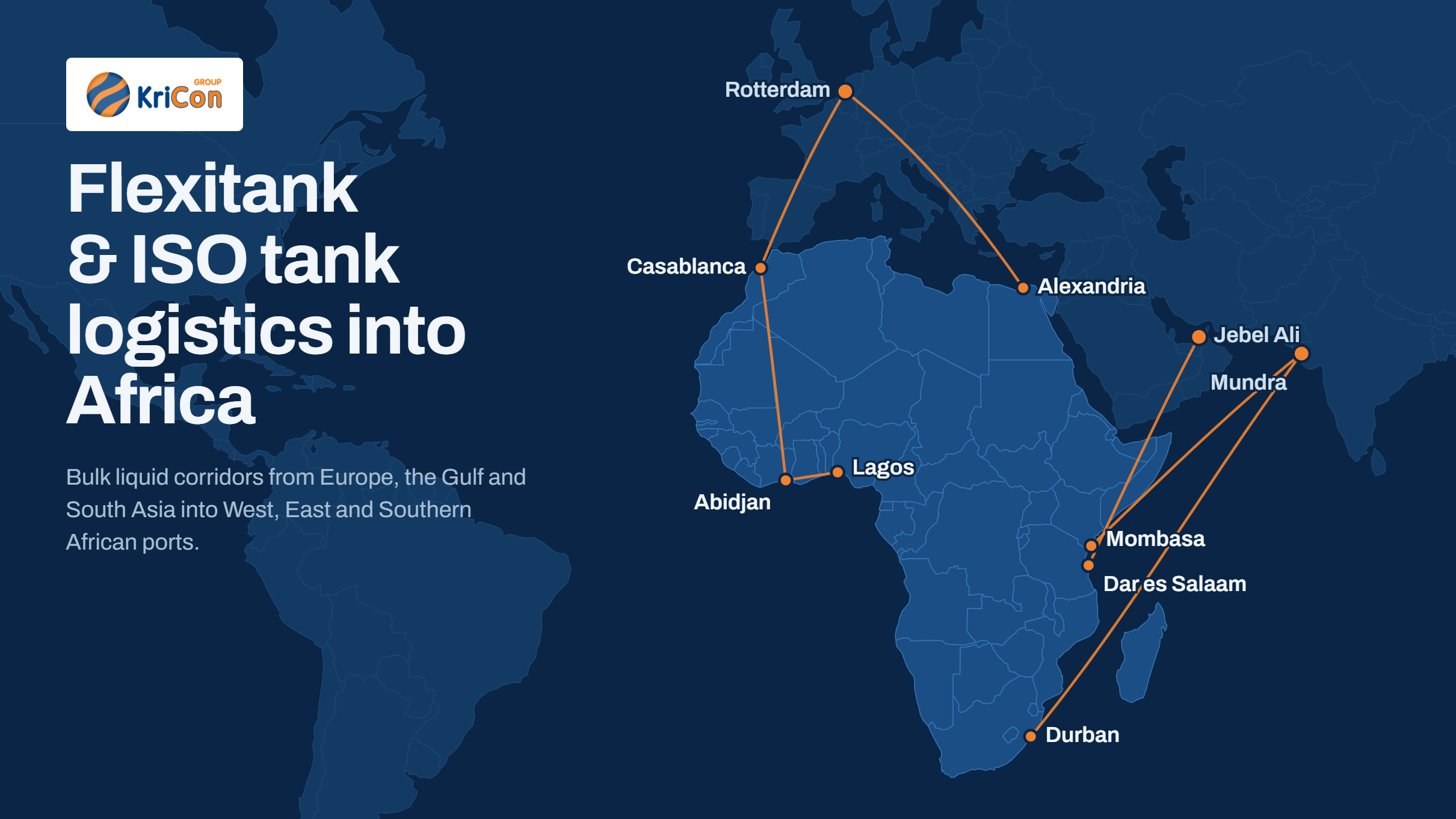
Quick answer: Kricon Group provides flexitank and ISO tank container logistics for bulk liquid cargo to and from Africa, with active trade lanes through Lagos (Nigeria), Tema (Ghana), Abidjan (Côte d’Ivoire), Durban (South Africa), Dar es Salaam (Tanzania) and Mombasa (Kenya). Shipments are coordinated from Kricon’s European and Middle Eastern offices and executed through a vetted network of local depot, fitting and trucking partners at each port.
This guide walks through why bulk liquid logistics in Africa is changing, how flexitanks and ISO tanks fit into that shift, and what actually moves through each of the six ports Kricon Group serves.
Why Africa Is a Growing Bulk Liquid Trade Corridor
Africa’s edible oil, agro-processing, mining and oil & gas sectors are all cargo-intensive in ways that favour bulk liquid transport over drums and IBCs. A handful of structural trends are driving that shift:
- Agro-export growth. West Africa’s palm oil belt (Côte d’Ivoire, Ghana, Nigeria) and East Africa’s edible oil processing industry are both scaling up, and bulk liquid formats cut cost per tonne compared with packaged goods.
- Mining and oil & gas expansion. Copper and cobalt production in the DRC and Zambia, gold mining in Ghana and Tanzania, and oil exploration around the Niger Delta, Lake Albert (Uganda) and the Turkana Basin (Kenya) all consume large volumes of imported drilling fluids, base oils, solvents and processing reagents.
- Port and corridor investment. Upgrades at Lagos, Tema, Abidjan, Durban, Dar es Salaam and Mombasa, alongside inland corridors like the Northern Corridor (Mombasa to Uganda, Rwanda and eastern DRC) and the Central Corridor (Dar es Salaam to Zambia, Burundi and Rwanda), are steadily reducing the friction that has historically kept African bulk liquid trade offline.
- The African Continental Free Trade Area (AfCFTA). As intra-African trade rules simplify, ports increasingly function as regional gateways rather than single-country endpoints — a container landing in Dar es Salaam or Mombasa is often destined three or four borders inland.
None of this is news to shippers already active in the region. What’s changed is that flexitank and ISO tank operators built around European and Central Asian trade lanes — Kricon Group among them — have extended those same standards of depot certification, cargo compatibility checking and emergency response into African port pairs.
For a shipper weighing options, the practical effect is that cargo which once had to move in drums, IBCs or dedicated break-bulk parcels can increasingly move in a standard 20ft flexitank or ISO tank instead — with the cost-per-tonne, loading speed and reduced handling that format brings on every other trade lane it already serves.
Flexitank or ISO Tank: What Moves Africa’s Bulk Liquid Trade
Kricon Group runs two complementary formats into and out of Africa, and the choice between them usually comes down to cargo hazard classification, volume and whether the container needs to be reused on a backhaul.
Flexitanks are single-use, food-grade polypropylene bags fitted inside a standard 20ft container, holding 14,000–24,000 litres of non-hazardous liquid. They’re the default for edible oils, wine, juice concentrate and other food-grade or industrial cargo that doesn’t require IMDG hazard classification, and they let shippers use a standard dry container rather than sourcing a dedicated tank. Full specifications are covered in what a flexitank is and how it works.
ISO tank containers are stainless-steel, reusable tanks built to a defined T-code, suited to hazardous and non-hazardous chemicals alike, including cargo that flexitanks cannot legally carry. They’re the standard choice for drilling fluids, solvents and other IMDG-regulated imports moving into Africa’s mining and oil & gas sectors. See what an ISO tank container is for T-code and specification detail.
Both formats run through Kricon’s liquid bulk logistics services, covering booking, documentation, depot coordination, insurance and cargo compatibility screening at origin and destination.
Documentation, Customs and Compliance for African Bulk Liquid Shipments
Bulk liquid cargo moving into and out of Africa faces more documentation steps than the average dry container, and the requirements differ by country. A few considerations that shape how Kricon Group plans a shipment through any of the six ports below:
- Pre-shipment and conformity inspections. Several West African markets, Nigeria in particular, require pre-shipment or destination inspection and product conformity certification for certain imported chemicals before customs clearance is granted. Building this into the booking timeline early avoids demurrage at the port.
- Certificates of origin and analysis. Palm oil, cocoa liquid and other agro-export cargo typically travel with a certificate of origin, phytosanitary or quality certificate, and a certificate of analysis confirming the product meets the buyer’s specification — all arranged before the flexitank is sealed.
- MSDS and hazard classification. For ISO tank cargo such as drilling fluids and solvents, a current Material Safety Data Sheet and correct IMDG classification determine which depots can handle the fitting and which routings and carriers will accept the booking.
- Insurance and cargo compatibility. Kricon Group runs a compatibility check against the previous cargo carried in any ISO tank before it’s accepted for a new booking, and arranges cargo insurance appropriate to the commodity and route.
- Inland transit documentation. For cargo destined beyond the port of discharge — mining reagents moving from Dar es Salaam to the Zambian Copperbelt, or Turkana-bound drilling fluids moving inland from Mombasa — transit bonds and cross-border permits for the corridor country need to be in place before the container leaves the terminal.
None of this is unique to Africa, but the specific combination of requirements varies enough by country that shippers new to these lanes often lose time at the documentation stage rather than in transit. This is where a logistics partner already familiar with each port’s requirements makes the difference between a straightforward booking and a container sitting on demurrage.
Kricon Group’s African Trade Lanes, Port by Port
Nigeria — Lagos (Apapa & Tin Can Island)
Lagos is West Africa’s largest port complex and Nigeria’s primary gateway for both agro-export and industrial import cargo. On the export side, Kricon Group moves flexitank shipments of Nigerian agro-processing output — including sesame oil and cocoa liquid — destined for European and Middle Eastern buyers. On the import side, Nigeria’s Niger Delta oil and gas sector, served through Lagos and the specialised Onne/Port Harcourt terminal, drives steady demand for imported drilling fluids, base oils and solvents delivered by ISO tank.
Ghana — Tema
Tema handles the bulk of Ghana’s containerised trade and sits at the centre of West Africa’s palm oil and cocoa belt. Ghana is one of Africa’s established palm oil producers, and flexitank exports of crude and refined palm oil move through Tema alongside cocoa butter and cocoa liquor — both regularly shipped in flexitank rather than packaged formats. Import demand runs the other way: Ghana’s gold mining sector, concentrated around Obuasi and Tarkwa, pulls in mining reagents and process chemicals through the same port.
Côte d’Ivoire — Abidjan (and San Pedro)
Côte d’Ivoire is Africa’s largest palm oil producer, and Abidjan — alongside the secondary port of San Pedro — is the main export point for that trade, moving alongside cocoa liquid and cocoa butter shipments in flexitank. On the import side, offshore oil exploration and production off Côte d’Ivoire’s coast generates demand for drilling fluids and base oils delivered by ISO tank, arriving through the same port infrastructure.
South Africa — Durban
Durban is the busiest container port in sub-Saharan Africa and South Africa’s main artery for both agro-export and industrial import cargo. Bulk wine and citrus juice concentrate move out through Durban in flexitank — South African bulk wine exports to Europe are among the most established flexitank trade lanes on the continent. Coming in, South Africa’s mining and manufacturing base — among the most developed in Africa — imports base oils, lubricants and process chemicals by ISO tank to supply operations from the Bushveld Complex to the Western Cape.
Tanzania — Dar es Salaam
Dar es Salaam is less an endpoint than a gateway: the Central Corridor connects the port to landlocked Zambia, the DRC, Burundi, Rwanda and Malawi. Import cargo landing here — drilling fluids, base oils and mining process chemicals by ISO tank — is frequently destined for the Zambian and Congolese Copperbelt hundreds of kilometres inland, rather than for Tanzania itself. On the export side, Tanzanian edible oil processing and sisal production contribute flexitank export volumes moving back through the same corridor.
Kenya — Mombasa
Mombasa anchors the Northern Corridor, serving Kenya, Uganda, Rwanda, South Sudan and eastern DRC. Kenya’s own edible oil refining industry is a significant importer of crude palm oil, arriving by flexitank for local processing — a reminder that Africa’s palm oil trade runs in both directions depending on where refining capacity sits. Mombasa also handles ISO tank imports of base oils, solvents and drilling fluids feeding regional oil exploration around Uganda’s Lake Albert and Kenya’s Turkana Basin.
How Kricon Group Operates Across These Six Ports
Kricon Group does not run its own branch offices in Africa. What it runs instead is a coordination model built over 15+ years of European, Middle Eastern and Central Asian bulk liquid logistics: booking, documentation, cargo compatibility screening and customer communication are handled from Kricon’s existing office network, while fitting, depot handling, trucking and on-the-ground execution at each African port are carried out through a vetted network of certified local partners.
This partner-based structure is deliberate rather than a limitation. It lets Kricon Group extend the same depot certification standards, emergency response protocols and cargo compatibility checks it applies on established European lanes to ports where building owned infrastructure wouldn’t yet make commercial sense — while giving shippers a single point of contact and a single set of documentation standards from origin to destination, whichever of the six ports the cargo moves through.
Frequently Asked Questions
Does Kricon Group operate in Africa? Yes. Kricon Group moves flexitank and ISO tank cargo through six African ports — Lagos, Tema, Abidjan, Durban, Dar es Salaam and Mombasa — coordinated from its European and Middle Eastern offices and executed through a network of vetted local depot and trucking partners at each port.
Which African ports does Kricon Group serve for flexitank and ISO tank shipments? Lagos and Tin Can Island (Nigeria), Tema (Ghana), Abidjan and San Pedro (Côte d’Ivoire), Durban (South Africa), Dar es Salaam (Tanzania), and Mombasa (Kenya).
What products typically move by flexitank between Africa and the rest of the world? Common export cargo includes palm oil, cocoa liquid and cocoa butter, bulk wine, and citrus juice concentrate. Common import cargo — usually by ISO tank rather than flexitank — includes drilling fluids, base oils and industrial solvents for the oil, gas and mining sectors.
What’s the difference between flexitank and ISO tank for African trade lanes? Flexitanks are single-use bags fitted inside a standard container for non-hazardous liquids up to roughly 24,000 litres, commonly used for edible oils, wine and juice concentrate. ISO tank containers are reusable steel tanks that can carry both hazardous and non-hazardous cargo, and are the standard choice for regulated chemicals such as drilling fluids and solvents.
Can hazardous chemicals be shipped into Africa by ISO tank? Yes. ISO tank containers are built and certified to carry IMDG-classified hazardous cargo, including many of the chemicals used in mining and oil & gas operations. Flexitanks are restricted to non-hazardous cargo only.
How long does flexitank or ISO tank shipping take from Europe to African ports? As a general guide, transit from major European load ports to Lagos or Tema runs roughly 2–3 weeks, to Durban roughly 3–4 weeks, and to Dar es Salaam or Mombasa roughly 3–5 weeks, depending on routing and transshipment. Exact transit times depend on origin port, carrier and sailing schedule — confirm current transit times with Kricon Group’s team for a specific booking.
Ship Your Bulk Liquids To and From Africa with Kricon Group
Whether it’s palm oil moving out of Tema or Abidjan, drilling fluids landing in Lagos or Dar es Salaam, or bulk wine leaving Durban, Kricon Group can quote flexitank and ISO tank logistics across all six African trade lanes above. Get in touch with Kricon Group’s team for a quotation on your next African shipment, or explore the full range of flexitank services offered globally.